
Behind the Scenes: How We Filtered Patients and Conducted the PMP-LLM Study
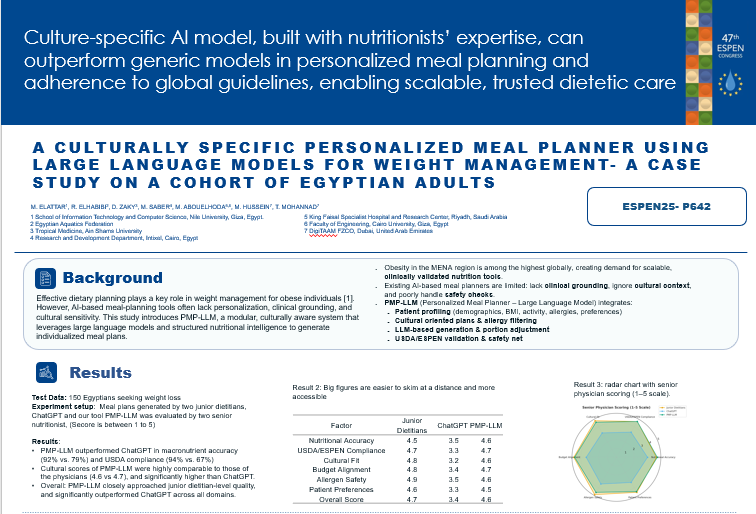
It All Starts With People, Not Code When we think about artificial intelligence in nutrition, it is easy to focus on the algorithms and models that power meal planning. Yet, in practice, the real work begins with the people. For our study presented at ESPEN 2025, where we introduced PMP-LLM—a culturally specific, AI-driven personalized meal planner for weight management—the foundation was not just in coding or datasets. It was in the meticulous process of patient selection, filtering, and structured evaluation. Finding the Right 378 Voices We chose to work with obese Egyptian adults, a group where the health need is both pressing and representative of a broader regional challenge. After careful screening, we recruited 378 participants, with an average age of 34.2 years and a mean BMI of 33.8. Importantly, all participants were otherwise healthy, allowing us to focus squarely on the nutritional aspects of the intervention without interference from uncontrolled chronic illnesses. More Than BMI: The Art of Filtering Filtering participants went far beyond defining age ranges or BMI thresholds. It was about ensuring that the AI-generated recommendations were both safe and relevant. Around 22% of the participants had dietary restrictions, ranging from religious practices to lifestyle choices such as vegetarianism. Another 13% reported food allergies, which had to be flagged as strict exclusions in every meal plan generated. On top of this, we factored in the cultural context. Food is deeply tied to tradition, identity, and daily life, so we filtered out foods that were uncommon, unavailable, or socially unacceptable in an Egyptian context. This three-layer filtering—dietary restrictions, allergies, and cultural fit—was critical to creating a study that measured real-world effectiveness rather than theoretical accuracy. Four Meal Plans, One Big Question Once the cohort was established, each participant received four sets of meal plans. The first was designed by senior physicians, serving as the reference standard. The second came from junior dietitians, representing everyday clinical practice. The third set was generated using a commercial AI tool, ChatGPT, which we used as a benchmark for current publicly available technology. Finally, participants received plans from our own system, PMP-LLM, developed by DigiTAAM. This system integrates detailed patient profiling, a culturally aware food database, validation against USDA and ESPEN guidelines, portion control, and multi-layered safety checks. Putting AI to the Test Evaluation was just as structured as the filtering process. Two senior physicians independently assessed all meal plans, using a five-point scoring system to measure nutritional accuracy, adherence to USDA and ESPEN guidelines, cultural appropriateness, allergen safety, and alignment with patient preferences. This evaluation framework ensured that we were not only comparing numbers and nutrient balances, but also testing the lived experience of following such a plan. Numbers That Tell a Story The results were compelling. PMP-LLM outperformed commercial AI systems in both macronutrient accuracy and USDA compliance . Its cultural compatibility score averaged 4.6 out of 5, which was nearly indistinguishable from physician-designed plans at 4.7 and substantially higher than the 3.2 achieved by generic AI systems. While junior dietitians retained a slight edge in nuance and allergen sensitivity, PMP-LLM consistently delivered plans that matched or closely approached dietitian-level quality. What We Learned Along the Way The key lesson from this experience is clear: personalization does not begin with the algorithm—it begins with the patient. By embedding safety checks, cultural awareness, and careful filtering into both the study design and the AI system itself, we were able to demonstrate that AI can move beyond generic suggestions to deliver clinically relevant, culturally specific, and patient-centered solutions. Beyond the Study: The Bigger Picture As we look forward, the implications are significant. With systems like PMP-LLM, it becomes possible to scale nutrition planning to large populations while still respecting the individuality of each patient. For regions like the Middle East and North Africa, where obesity rates are among the highest globally, this approach represents not just an innovation in technology, but a new pathway to more accessible and effective healthcare.